Copper-Nickel Flanges
C70600 90/10 and C71500 70/30 flanges for seawater, firewater, ballast and condenser service. Machined to ASME B16.5 patterns or to your print.
Copper-nickel is the default alloy for seawater piping, and it has held that position for more than half a century. It is not the strongest material available, and it is not the cheapest. It wins because it forms a protective film in clean seawater and then stops corroding, and because barnacles will not colonize it.
Texas Flange machines copper-nickel flanges from plate, bar and forgings. The dimensional pattern is usually an ASME B16.5 footprint so the flange bolts into a standard system, but we also work to naval specifications and to customer drawings.
The two grades
Almost all copper-nickel flange work is one of two alloys. The split between them comes down to velocity, temperature and strength.
| Property | C70600, 90/10 | C71500, 70/30 |
|---|---|---|
| Nickel | 9 to 11% | 29 to 33% |
| Iron, deliberate addition | 1.0 to 1.8% | 0.4 to 1.0% |
| Relative strength | Lower | Roughly 40 to 50% higher tensile |
| Seawater velocity tolerance | Lower, commonly held near 10 ft/s in pipe | Higher, commonly held near 14 ft/s in pipe |
| Elevated temperature capability | Lower | Higher |
| Resistance to sulfide-polluted water | Somewhat better | More sensitive |
| Relative cost | Lower | Higher |
| Where it lands | General seawater and firewater distribution | Pump discharge, condensers, high velocity headers |
Velocity is the design variable. The figures above are orientation numbers for straight pipe. Real limits fall at elbows, tees, partially closed valves and anywhere entrained air or solids concentrate. A line that averages 8 ft per second can still be well past the limit locally at the outside of a short radius elbow. Confirm the limit with your design authority for the actual geometry.
How the protective film works
In clean aerated seawater, copper-nickel grows a thin cuprous oxide layer, and the iron addition in the alloy makes that layer adherent and erosion resistant. The film takes weeks to mature. Once it has, corrosion rates drop to very low values and stay there.
Two things break it. Excess velocity shears the film off faster than it rebuilds, which shows up as erosion-corrosion, typically as horseshoe-shaped pits pointing downstream. Sulfide-polluted or oxygen-free water grows a black cuprous sulfide film instead, which does not protect, and which leaves the metal vulnerable once oxygen returns.
The practical consequence is about commissioning, not design. A new system filled with stagnant harbor water while the contractor finishes other work can be compromised before it ever runs. Keep it flowing on clean seawater, or drain and dry it.
Material specifications
ASTM B171copper alloy plate for pressure vessels, condensers and heat exchangers. The usual source for plate and ring flanges, and for blinds.ASTM B466seamless copper-nickel pipe and tube. The mating pipe on weld neck and slip-on work.ASTM B467welded copper-nickel pipe, used on large diameter seawater headers.ASTM B151copper-nickel rod, bar and shapes, for machined small-bore flanges.ASTM B111copper alloy condenser tube, where the flange serves a tube bundle.MIL-F-1183and related naval fitting specifications on Navy shipboard work.
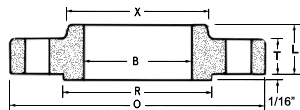
Flange types we supply in copper-nickel
Slip-on dominates copper-nickel seawater piping. It is easier to fit, and the fatigue duty in a seawater distribution system rarely justifies a weld neck. Weld neck still belongs anywhere the line sees pressure cycling, vibration or thermal movement.
- Slip-on, welded inside and out, the common choice
- Weld neck, where fatigue or pressure demands a butt weld
- Blind, usually cut from B171 plate
- Lap joint and stub end, with a cheaper backing ring to cut alloy cost
- Threaded and socket weld, small bore and instrument connections
- Plate and ring, flat rings cut from plate, including waterworks patterns
Welding and fabrication notes
Copper-nickel welds readily, but it is not steel and it does not forgive the same habits. A few points that come up on every job:
- Filler is normally a 70/30 type consumable even on 90/10 base metal, because the extra nickel covers dilution and keeps the weld metal sound.
- Copper alloys are sensitive to iron and sulfur pickup. Keep steel brushes, steel grinding media and steel layout tables away from the prep, and use dedicated stainless or non-ferrous tooling.
- No preheat is wanted beyond removing moisture, and interpass temperature should be kept low. Heat is not the friend here that it is on carbon steel.
- Cleanliness matters more than on steel. Oxide, oil and marker ink all cause porosity.
- Root protection with argon on the inside of a butt weld keeps the bore clean, which matters because the bore is the surface that has to grow a protective film.
See also welding and joining copper-nickel flanges and choosing 90/10 or 70/30 copper-nickel.
Common questions
Is 70/30 always the safer choice over 90/10?
No. It is stronger and takes more velocity, but it is also more expensive and it is more sensitive to sulfide pollution during commissioning. Where the design velocity sits comfortably inside the 90/10 range, 90/10 is the correct engineering answer, not just the cheap one.
What iron content should a copper-nickel flange have?
The ASTM range for C70600 is roughly 1.0 to 1.8 percent iron, and for C71500 roughly 0.4 to 1.0 percent. Iron builds the erosion-resistant film. Ask for the MTR and check the iron line, not just the nickel line.
Can I use copper-nickel flanges on a carbon steel line?
Only with the galvanic couple broken. Copper-nickel is cathodic to carbon steel, so the steel corrodes at the joint. Use an insulating gasket kit with bolt sleeves and washers, or run a spool of the same alloy so the transition happens at a controlled, inspectable point.
Do copper-nickel flanges need a corrosion allowance?
Far less than steel. Once the protective film forms in clean aerated seawater, long term corrosion rates are very low. The failure mode to design against is erosion-corrosion from excess velocity, not general wastage, so velocity control matters more than a thickness allowance.
How do you commission a new copper-nickel seawater system?
On clean, aerated, moving seawater, and keep it moving. Letting a new system sit full of stagnant polluted harbor water before the protective film has formed is the single most common way to compromise it permanently. If a layup is unavoidable, drain and dry it instead.
Copper-nickel flanges to pattern or to print
Send the size, class, alloy and bore and we will quote it. If the job is off-pattern, send the drawing.
Send the print, or send the size, class and grade. Texas Flange quotes quickly.
Request a QuoteOr call 281-484-8325 and ask for the copper flanges desk.